
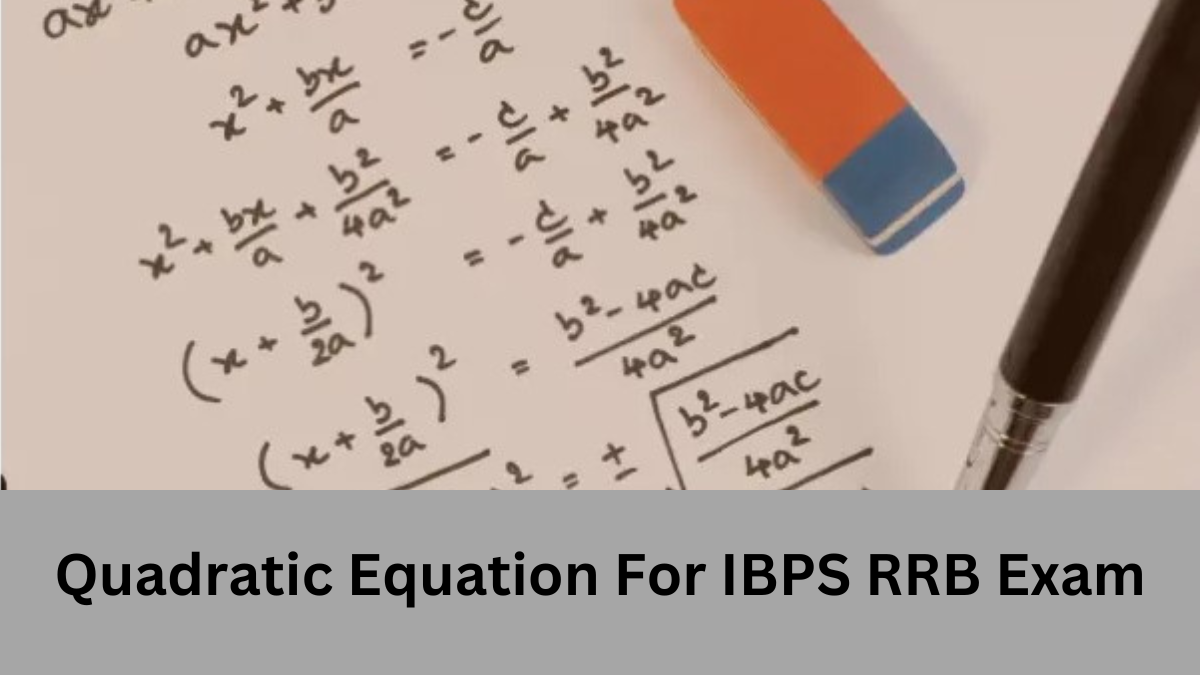

Solving quantitative aptitude questions quickly can often determine whether a candidate clears the cut-off in a bank exam. One of the most scoring yet often misunderstood topics is quadratic equations. These problems might appear simple at first glance, but without clarity in approach, they can consume time or lead to avoidable mistakes.
The topic often tests logical thinking and algebraic manipulation, both of which are crucial in high-stakes competitive exams. When preparing with practice papers or mock tests, learners frequently encounter quadratic equations for bank exam preparation. This article explores how to enhance speed and accuracy in this area through practical methods, core concepts, and a strategic preparation approach.
Learn to Spot the Pattern Behind the Equation
Many quadratic problems follow repeatable patterns. Recognising these forms instantly saves time during the test. For example, questions often feature standard formats such as x2+bx+c=0x^2 + bx + c = 0x2+bx+c=0, where factorisation helps quickly identify the solution.
Being able to mentally break down the equation into factors like (x+m)(x+n)=0(x + m)(x + n) = 0(x+m)(x+n)=0 provides a solid shortcut. Candidates must train their minds to link patterns with corresponding factor pairs. Memorising the sign rules for constants and coefficients also boosts reaction speed during solving.
Build Conceptual Strength in Basic Algebra
Before diving into speed-based tricks, building strong basics matters most. Understanding what makes an equation quadratic and identifying the degree of the equation are primary skills. Without this clarity, attempting shortcuts may lead to errors. Work consistently on rules involving signs, roots, and coefficients.
These foundations create confidence in handling complex-looking problems. Try converting word-based problems into equations and then solving them using routine algebraic steps. This habit boosts accuracy in real-time test conditions.
Apply Elimination for Option-Based Solving
Bank exams often present multiple-choice questions. Candidates can use reverse-solving strategies by substituting options into the equation. This technique eliminates incorrect answers, narrowing the choices. In many cases, one or two substitutions reveal the correct pair of values.
This method works especially well when factorisation or formula application seems lengthy. With practice, the mind adapts to quicker elimination patterns. Time saved on such questions can then be used on lengthier reasoning problems elsewhere in the paper.
Practice with Quadratic Equations PDF for Bank Exam
Building confidence in this topic requires focused practice. Quadratic equation sets are specially curated to mirror real test conditions. Working with these resources helps improve the recognition of patterns, question types, and common traps.
- Use a Timer While Solving
Allocate a fixed time for each equation. Gradually reduce time limits to improve speed. - Analyse Mistakes After Each Attempt
Review where the solving process went wrong and what step caused confusion. - Use PDF Sets with Answers
Refer to the PDFs that include both questions and solutions for guided practice. - Track Accuracy and Speed Together
Create a record to monitor the rate of correct answers per minute for progress tracking.
Avoid Common Mistakes During Calculation
Small calculation errors often turn correct logic into the wrong answer. These include misreading signs, skipping steps, or mishandling square roots. Focus on step-by-step solving during practice to create accuracy habits. Double-check the sign of the coefficients before solving.
A common trap is switching the sign while moving a term across the equals sign. Precision in such small details drastically changes outcomes. Avoid the temptation to rush if unsure about the sign rules or value substitution.
Quadratic equations for bank exam preparation demand both speed and accuracy from every candidate. They offer a strong scoring opportunity for those who practice with a disciplined approach. Mastering this topic takes a blend of concept clarity, regular practice, and smart strategy. By staying consistent and reviewing mistakes, success becomes a predictable outcome, not a lucky break.